If you like The Hollies, check out these professional music artists
4 Way Street, 10 cc, Everly Brothers, Fountains of Wayne, Terry Reid, Alan Parsons Project, The Miracles, Smokey Robinson & The Miracles, The Raspberries, Hollies, Crosby Stills & Nash, The Romantics, Albert Hammond, Allan Clarke, Crosby Stills Nash & Young, Freedy Johnston, Chip Taylor, Samantha Sang, The Cavern Club, Crosby, Stills & Nash, Abaddon, Abortion, Abominant, Michael Callen, Caedere, Uhrilehto, Failed Humanity, Kabbal, Damnation, Kalibas, Fleshless, Lacerate, Apoptygma Berzerk, Misery Index, Kataplexia, The Dave Matthews Band, R. Dean Taylor, Razorlight, Butterfly Boucher, UbikaMore Undetermined Music...
|
|
|
|
The Hollies are an English rock and roll band formed in the early 1960s. Known for their distinctive vocal harmony style (which influenced many other groups) they became one of the leading British bands of the era, and they enjoyed considerable popularity in many other countries (including Australia) although they did not achieve major US chart success until the early 1970s
. Like The Rolling Stones they are also notable as one of the only British pop bands of the Sixties that has not broken up and which continues to record and perform to the present.
HistoryFormationAlthough the group admired Buddy Holly, their name was inspired primarily by the sprigs of holly in evidence around Christmas of 1962, at the time they re-formed their previous band, The Deltas, and had to come up with a new name. [1] The original lineup included Allan Clarke as lead vocalist, Graham Nash as guitarist and backup vocalist, Jeremy Levine on rhythm guitar, with Eric Haydock and Don Rathbone rounding out the group on bass and drums. Levine, due to a run in with the law, was dismissed from the group shortly before they signed to Parlophone in 1963 as label-mates of The Beatles. The group released their first album in the United States in 1964 as part of the first wave of British Invasion releases. They are commonly associated with Manchester, as some of the original Hollies grew up in the city, but other band members came from East Lancashire towns. Tony Hicks then Bobby Elliot who both played in a Nelson, Lancashire based band, the Dolphins, joined the band in quick succession in 1963. Bernie Calvert who replaced Haydock in 1966 was also a Dolphin member.
1960sThe Hollies had a squeaky-clean image, and were known for their bright vocal harmonies. They scored their first British hit in early 1964 with a cover of Maurice Williams and The Zodiac's "Stay" which hit #8 in the UK charts. They followed up with a cover of Doris Troy's "Just One Look". Frequent releases during the mid-60s included many cover versions of popular songs, as well as a few group-penned hits and many songs written by professional songwriters.
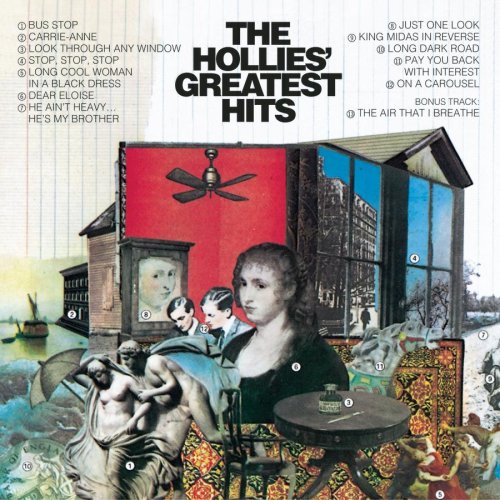
The Hollies was one of the most successful British 'singles' bands of the 1960s, scoring twenty-two UK Top 40 placings between 1964 and 1970. Their hits include "Here I Go Again" (#4, 1964), "Look Through Any Window" (#4, 1965, U.S. #32), "Yes I Will" (#9, 1965), their only British #1 single "I'm Alive" (U.S. #103) (1965), three UK #2 hits during 1966 -- "Bus Stop" (U.S. #5) (written by future 10CC member Graham Gouldman), "I Can't Let Go" (U.S. #42) and "Stop Stop Stop" (U.S. #7) -- "Carrie Anne" (#3, 1967, U.S. #9, from which actress Carrie-Anne Moss got her name, having been born when the song was on the charts), "On a Carousel" (#4, 1967, U.S. #11) and "Jennifer Eccles" (#7, 1968, U.S. #40), their last single with Graham Nash.
The rhythm section included drummer Bobby Elliot and bass guitarist Eric Haydock. Bernie Calvert replaced Eric Haydock in 1966. Producer Ron Richards criticized Calvert's bass playing in the liner notes to Epic Records' 20 Song Anthology.
Drummer Bobby Elliot in the 1960s
Some of their songs had folk rock elements (e.g., Would You Believe?), and psychedelic influences (For Certain Because, Evolution and Butterfly). "If I Needed Someone" (No. 20, 1965), was a George Harrison composition, recorded by The Beatles on Rubber Soul. "King Midas in Reverse" (No. 18, 1967), an original Hollies song, was influenced by prevailing trends in psychedelia, with a strings, brass and flute arrangement.
Graham Nash's departureWhen Nash left in 1968 due to creative differences, in particular over the plan to record a full album of Dylan songs, he joined forces with former Buffalo Springfield guitarist Stephen Stills and ex-Byrds singer David Crosby to form one of the first supergroups, Crosby, Stills & Nash. He was replaced by guitarist-singer Terry Sylvester, formerly of the The Swinging Blue Jeans. This lineup had a hit in 1969 with "Sorry, Suzanne", which reached No. 3 in the UK.
1970sThe group hit No. 3 again in 1970 with the emotional civil rights themed ballad "He Ain't Heavy, He's My Brother", which featured the piano playing of Elton John. Band member Allan Clarke briefly left the group in 1971 for a solo career. With the end of their EMI/Parlophone contract they signed with Polydor, and Swedish singer Mikael Rickfors sang on the song "The Baby". Meanwhile EMI had taken a two-year-old track from their album "Distant Light", which had Clarke on lead vocal and lead guitar, the Creedence Clearwater Revival-inspired song, "Long Cool Woman in a Black Dress", as a rival single, reaching #2 in the US and #32 in the UK. Clarke rejoined in 1973 and they returned to the UK Top 30 with another swamp rock-style song penned by Clarke, "The Day That Curly Billy Shot Down Crazy Sam McGee".
In 1974 they had a UK No. 2 hit and US Top Ten success with the love song "The Air That I Breathe"; it had previously been recorded by Phil Everly on one of his solo albums. It was their last UK hit for over a decade. Subsequent singles like "Son of a Rotten Gambler", "I'm Down", "Boulder to Birmingham", and "Sandy" failed to chart.
1980s-2000sIn 1981 Calvert and Sylvester left and they recorded their own contribution, "Holliedaze", which returned them to the UK Top 30. Nash and Haydock briefly rejoined to promote the record on Top of the Pops. They continued to record and tour throughout the mid-1980s, last hitting the US Top 40 with a remake of The Supremes' "Stop in the Name of Love", which reached #29 in 1983, from the album What Goes Around. A live album featuring the Clarke-Hicks-Elliott-Nash regrouping, Reunion, followed that same year.
After its use in a TV beer commercial (for Miller Lite lager) in the summer of 1988, "He Ain't Heavy" was reissued in the UK and reached #1, thus establishing a new record for the length of time between chart-topping singles for one artist of 23 years. By this time bassist Ray Stiles, formerly a member of 1970s chart-topping glam rock group Mud, had joined the permanent lineup. A reissue early in 1989 of "The Air That I Breathe" only made #60. In 1993 another new single, "The Woman I Love", written by Nik Kershaw, reached #42 in the UK.
The Hollies still tour with two original members, Hicks and Elliott. After Clarke's retirement in 1999, he was replaced by Carl Wayne, former lead singer of The Move. Wayne only recorded one song with them, "How Do I Survive", the last (and only new) track on the 2003 Greatest Hits. After his death from cancer in August 2004, he was replaced by Peter Howarth. The Hollies' first new studio album since 1983, Staying Power was released in 2006.
The bridge was taken and retooled from the verse of The Hollies song "The Air That I Breathe" written by Albert Hammond and Mike Hazelwood in the 70s to form part of the Radiohead song "Creep". After taking issue, Hammond and Hazelwood now share a small portion of the songwriting credits and royalties.needed
Line-ups - Allan Clarke - lead vocals, guitar, harmonica
- Alan Coates - guitar, banjo, vocals
- Tony Hicks - guitar, banjo, mandolin, bass, keyboards, vocals
- Alan Jones - bass
- Bobby Elliott - drums
- Brian Chatton - keyboards
DiscographySee The Hollies discography
Copyright Citations
This article is licensed under the GNU License
Click here for original article: The Hollies
|
|