More Info on Tony BanksSimilar Undetermined MusicSearch Artistopia
Biography
This article is about the musician. For other people named Tony Banks, see Tony Banks
Infobox musical artist| Background = non_vocal_instrumentalist | Instrument = Piano , Keyboard instrument|Keyboards , Vocals , Guitar , Bass guitar , Drum kit|Drums , Percussions | Name = Tony Banks | Img = Banks.jpg | Born = birth date and age|df=yes|1950|03|27 East Hoathly , East Sussex , England | Genre = Progressive rock Classical music|Classical Pop rock | Associated_acts = Genesis (band)|Genesis Bankstatement Strictly Inc. | Notable_instruments = Hammond organ#T series|Hammond T-102 | Years_active = 1967�present | Label = Charisma Records Polydor Records Virgin Records Atlantic Records Giant Records (Warner)|Giant Records Reprise Records Naxos Records | Notable_instruments = Korg Wavestation|Korg Wavestation EX , Korg Oasys , Roland JD-990 , Roland JV-1080 | URL =
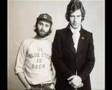
Anthony George "Tony" Banks (born 27 March 1950) is an England|English composer , and multi-instrumentalist , who performs as a keyboardist and a guitarist . He is one of the founding members of progressive rock group Genesis (band)|Genesis and one of only two members (the other being bassist/guitarist Mike Rutherford ) who have been with Genesis throughout its entire history.
As a member of Genesis, Banks has been a pioneer in the use of synthesisers , as well as in the use of many other keyboards (such as the Electric grand piano|Yamaha CP-70 and as an organist , notably on the Hammond organ#T series|Hammond T-102 ). Through most of the band's history, Banks was the leading force in Genesis' songwriting; although the group was often responsible as a whole for composing songs, his ideas were often the nucleus of their music, and he would frequently write lyrics as well. Outside of Genesis, Banks has enjoyed a modestly successful career in the world of Film score|film scoring , and a limited solo career as well. He was inducted into the Rock and Roll Hall of Fameas a member of Genesis in 2010.
Early years
Banks is the most private of the Genesis members; most of what is known about his early life is from the book on Genesis by Armando Gallo .
Banks was born in East Hoathly , Sussex , England . He received classical training in piano, and taught himself to play guitar. He attended Charterhouse School where he met fellow pupil Peter Gabriel in 1963. Banks originally planned to study mathematics in higher education, and after Charterhouse he took a leave of absence from Sussex University to explore Genesis, and never returned.Gallo
Banks and Gabriel, together with drummer Chris Stewart (author)|Chris Stewart , formed a band called The Garden Wall. This band merged with another called Anon, which included Mike Rutherford and Anthony Phillips . They recorded a set of demos which ultimately led to the formation of the band that became Genesis.
Career in Genesis
Banks' elaborate arrangements and keyboard solos & mdash; such as the piano introduction to " Firth of Fifth " and the instrumental sections of " The Cinema Show ", " Watcher of the Skies ", and " Supper's Ready "& mdash; helped to establish Genesis' sound. In addition to playing keyboards, Banks contributed (along with Steve Hackett and Mike Rutherford) to Genesis' 12-string acoustic passages in songs such as " The Musical Box (song)|The Musical Box ", " Entangled (song)|Entangled ", " The Cinema Show ", and the beginning part of " Supper's Ready ". Banks also was an occasional back-up vocalist and sang co-lead vocals on "Shepherd," an unreleased track from 1970 which finally surfaced on the Genesis Archive 1967-75 boxed set.
Banks's compositions are credited to be the driving force of Genesis' music, particularly in material recorded before 1979. Notable Banks-penned Genesis songs include "Mad Man Moon," "One for the Vine" and the anthemic ballad " Afterglow (Genesis song)|Afterglow ", which remained a popular coda to the Banks-driven "medleys" (conglomerations of Genesis' most-popular keyboard solos) that the group played during live shows for years.
After much speculation, Genesis announced a reunion tour in 2006; when Gabriel declined to perform, it was decided by the band members that the three-person lineup would be more appropriate, and Daryl Stuermer and Chester Thompson were invited to perform. Turn It on Again: The Tour began on 11 June 2007 in Helsinki, and ended on 13 October 2007 at the Hollywood Bowl .
In March 2010, Phish guitarist Trey Anastasio was asked to pay tribute to Genesis, one of his favourite bands, upon their induction to the Rock & Roll Hall of Fame . In addition to Anastasio's speech, Phish appeared and performed two Genesis songs, " Watcher of the Skies " and " No Reply At All ". Even though Banks and his Genesis bandmates (minus Peter Gabriel) attended the ceremony, they did not perform.
Equipment
Banks achieved a distinctive sound by running all of his keyboards (as well as his 12-string guitar) into a mixing board and then running the signal output of the board into a Leslie Speaker . This can clearly be heard on everything Banks plays on the Genesis Live album.
Banks's earliest setup included a Hammond organ#L-100 series|Hammond L-100 organ , a Hohner Pianet and a Mellotron Mark 2, all of which (as well as grand piano) are first heard on the " Trespass (album)|Trespass " album.
Banks used the Hohner Pianet as both a substitute for a grand piano, and also as a lead instrument, with the use of a Distortion (music)|fuzz box . He would often duel with Steve Hackett's guitar, as heard on tracks like " The Musical Box ", " The Return of the Giant Hogweed ", or " Supper's Ready ". Banks later switched to an Rocky Mount Instruments|RMI 368x Electra Piano and Harpsichord , which was soon integrated into the sound of Genesis, as first heard at various points on The Lamb Lies Down On Broadway album. After 1978, the RMI was replaced with the Yamaha electric grand piano|CP-80 electric grand piano .
The first synthesiser to be used by Genesis was the monophonic ARP Pro Soloist , which Banks first acquired in 1973. After 1975, Banks ditched the Leslie for the MXR Phase 100 and Boss Corporation|Boss CE-1 Chorus effects pedals on his organ (which he switched from the L-100 to a Hammond organ#T series|T-102 . He used this technique all the way up to Duke (album)|Duke in 1980. On Abacab in 1981, the organ was no longer featured; organ sounds were emulated using a Sequential Circuits Prophet 10 synthesiser. The mellotron was later changed to a M400 model, and later phased out altogether with the addition of the Prophet 10 and the polyphonic ARP Quadra synthesizer.
Sound innovations
Banks pioneered many unique keyboard and synthesiser sounds throughout his career; music historian Wayne Studer has referred to him as "the most tasteful keyboardist of prog rock.".geowayne.com/favorites.htmOne of his achievements was the technique of using the trigger output of a LinnDrum drum machine to have the hi-hat pattern trigger an ARP Quadra synthesiser, creating such parts as the pulsating drum sound in " Mama (Genesis song)|Mama " (from 1983's Genesis (Genesis album)|Genesis ) and "By You" on The Fugitive . Another unique synth technique was used on the track " Who Dunnit? (song)|Who Dunnit? " from the 1981 album Abacab ; a Sequential Circuits Prophet-5 was programmed with a few sounds, and the patches were switched manually (via the panel preset tabs) while he played.
Banks used a cross-hand playing style in several songs to allow himself to play faster. This is notable on " The Lamb Lies Down on Broadway (song)|The Lamb Lies Down on Broadway " and " The Carpet Crawlers ". He also used the cross-hand technique on " No Reply At All " (which can be seen briefly in the accompanying music video), " In the Cage (song)|In the Cage " (as per When in Rome 2007 DVD) and " Fading Lights ".
Career outside Genesis
Film scoring
Banks has also created some film score s. The movie The WickedLady features a score by Banks as well as The Shout , co-credited with Mike Rutherford and Rupert Hine. He wrote the soundtrack to Quicksilver (film)|Quicksilver , starring Kevin Bacon , the single from which was produced by Richard James Burgess . After Genesis went into hiatus in 1998, Banks continued to write. A set of (mostly) recently-composed orchestral pieces was recorded and released on the 2004 album Seven: A Suite for Orchestra .
Solo career
After the departure of Peter Gabriel and guitarist Steve Hackett from Genesis, Banks was the first of the three remaining members of the group to release a solo album. But unlike Phil Collins and Peter Gabriel , who saw great solo success, and Mike Rutherford , who had a successful side career with Mike + the Mechanics , Banks's solo efforts usually sold only to a core audience of Genesis devotees. In 1998, fans formed a tribute band called http://www.strictlybanks.co.uk Strictly Banks, and performed a set of Banks's solo songs.
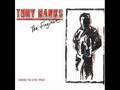
Apart from the album The Fugitive (Tony Banks album)|The Fugitive and selected other songs, Banks has employed guest vocalists on his solo albums; these have included (amongst others) Fish (singer)|Fish , Nik Kershaw , Toyah Willcox , Jack Hues and JimDiamond (Scottish musician)|Jim Diamond .
Banks's most recent solo release is entitled Seven (Tony Banks album)|Seven: A Suite for Orchestra which is in the classical genre. Banks's compositions are performed by the London Philharmonic Orchestra, conducted by MikeDixon (conductor)|Mike Dixon , and Banks himself played piano with the orchestra on three tracks. The album received a worldwide release on Naxos Records.
2004 Seven (Tony Banks album)|Seven: A Suite for Orchestra
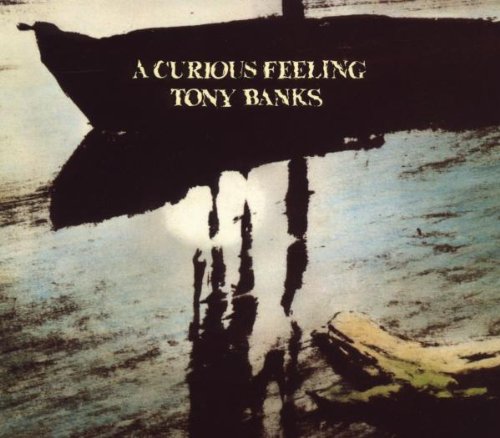
A Curious Feeling was remastered into new stereo and 5.1 mixes by Nick Davis and released in 2009 to commemorate the album's 30 year anniversary.
Instruments
While Banks's rig varied from year to year, many pieces of equipment made repeat appearances. Piano|Acoustic piano appeared on every album until 1982, although it was never brought on tour. Also, for some acoustic numbers, especially those from early Genesis, Banks joined Mike Rutherford and Steve Hackett on the 12-string guitar. Other keyboard instruments most associated with Banks include the Mellotron (initially a Mk II, but later an M400), the Hammond organ (at first an Hammond_Organ#L-100_series|L-122 , then a Hammond organ#T series|T-102 ), and the ARP Pro Soloist . Other frequently used pieces of gear included a Hohner Pianet N (from 1970�76), Yamaha electric grand piano s (from 1977 forward), and the Korg Wavestation (1991 forward). Banks's gear also varied from album to tour; the most notable example of this is his frequent replacement of keyboards with rack equivalents. Other instruments played by Banks include:
Banks currently lives with wife Margaret. The couple were married on July 29, 1972 and have two children Ben (b. 1978) and Emily (b. 1981).
Notes
reflist
External links
http://www.worldofgenesis.com/Biography-TonyBanks.htm World of Genesis.com Tony Banks Biography 1950-2008
http://www.worldofgenesis.com/TonyBanksInterview2004.htm World of Genesis.com Tony Banks 2004 Interview
http://worldofgenesis.com/TonyBanks-Interview2009.htm World of Genesis.com Tony Banks 2009 Interview
http://tonybanks.thewayiwalk.com/ Man Of Spells - The Tony Banks Fanlisting
commons category|Tony Banks Genesis Persondata | NAME = Banks, Tony | ALTERNATIVE NAMES = | SHORT DESCRIPTION = | DATE OF BIRTH = 27 March 1950 | PLACE OF BIRTH = | DATE OF DEATH = | PLACE OF DEATH = DEFAULTSORT:Banks, Tony Category:1950 births Category:Living people Category:People from East Hoathly Category:English rock keyboardists Category:English pianists Category:English songwriters Category:Genesis (band) members Category:Old Carthusians Category:Alumni of the University of Sussex Category:Charisma Records artists